In 1943, MGM released The Human Comedy, a film starring Mickey Rooney as Homer Macauley, a high school-aged telegram delivery boy in the mythical Central Valley town of Ithaca. The hit film was based on a script by Fresno native William Saroyan, who drew on his own high school experiences as a Postal Telegraph Company delivery boy in the early 1920s.
Saroyan hated the film, which he thought, writes biographer John Leggett, “was a miscarriage, an abomination among all films ever made” (143).
Fresh off success as a Pulitzer Prize-winning playwright, Saroyan had been brought into the MGM orbit with the blessing of Louis B. Mayer himself. Saroyan eventually pitched an idea for a screenplay whose surface sentimentality he thought would appeal to Mayer. In it, a fatherless telegram delivery boy helps support his small-town, all-American family and comes of age while delivering sometimes devastating news to families whose sons are overseas fighting the Second World War. Saroyan wanted to direct the production, but that didn’t fly with Mayer, who thought the original screenplay was too long and who knew Saroyan didn’t have the chops as a first-time director to helm the project. He hired veteran Clarence Brown to direct instead.
Embittered, Saroyan left MGM, quickly turned his screenplay into a highly successful novel, and, delicious turn here, still collected an Academy Award for “Best Original Story.” These days the movie is available via streaming (as is a 2015 reimagining directed by Meg Ryan entitled Ithaca), but it’s the novel that still serves as the best version of Saroyan’s story.
In it, Saroyan focuses on the people of Ithaca and their affections for each other, their kindnesses to strangers, their attachments to community, and their sorrows in loss. In some ways, the book is a departure from Saroyan’s previous work, which often featured characters inspired by his Armenian background, works like the 1940 short story collection, My Name Is Aram. Still, some of Homer’s background—including a deceased father as well as his telegram delivery job—mirror Saroyan’s own life growing up in Fresno, that is, the real-life model for fictional Ithaca.
Moving Along Swiftly
Main characters in Saroyan’s novel, besides Homer, include little brother Ulysses. These two names, along with a town called Ithaca, allude to The Odyssey and conjure one of its themes, the importance of home. Other characters are Postal Telegraph office manager Tom Spangler and telegrapher Willie Grogan, an elderly functioning alcoholic who was once “the fastest telegraph operator in the world” (101). The novel is episodic and offers what at first appears to be a facile, surface sentimentality.
However, sentiment is tempered in the book by the depiction of a complicated Ithaca, on one hand a place that pulses to its own rhythm and pace of movement and on the other hand a place that exists as a transit site that enables larger scale movements beyond city limits, a distinction between communication on a typed page delivered by a delivery boy and intelligence that, at the speed of light, arrives from afar as electrical impulses in the telegraph office. It’s the difference between at and through, local and express, distinctions partly defined by differences of scale but that also introduce a tension between stability and change. The question, the novel seems to argue, is in the face of rapid—and sometimes tragic—changes, what do you hold onto? The answer is home and family.
Movement provides the novel a useful scaffold for its home-centric theme, which The Human Comedy makes clear early in chapter two with a description of Homer biking home from a delivery:
Even though he was moving along swiftly, Homer was not missing any of the charm of the region. Look at that! he kept saying to himself of earth and tree, vine and sun and cloud. Look at that, will you? He began to make decorations with the movements of his bike and, to accompany these ornaments of movement, he burst out with a shouting of music-simple, lyrical and ridiculous. The theme of this opera was taken over in his mind by the strings of an orchestra, then supplemented by the harp of his mother and the piano of his sister Bess. . . .
When he reached the beginning of the residential district of the city, he passed a sign without reading it:
Ithaca, California
East, West—Home Is Best
Welcome, Stranger (14-15)
Fresno has a comparable landmark which proclaims a similar pride of place, the 1929 Van Ness Entrance Gate, which arches across Van Ness Avenue, and reads:
FRESNO
THE BEST LITTLE CITY IN THE U.S.A.
It’s not exactly the same message, but its celebration of the local is in the same key.

The introduction of Homer follows the opening of the book, where four-year old little brother Ulysses rushes from his own backyard to a local railroad crossing, alerted by the tremble in the earth of an approaching train. When he reaches the crossing, “. . . he was just in time to see the passing of the whole train, from locomotive to caboose. He waved to the engineer, but the engineer did not wave back to him. He waved to five others who were with the train but not one of them waved back. At last a Negro appeared leaning over the side of the gondola.” Tellingly, the man is singing “My Old Kentucky Home.” Ulysses waves to him, and “a wondrous and unexpected thing happened. This man, black and different from all the others, waved back to Ulysses, shouting: ‘Going home, boy—going back where I belong’” (12).
The two scenes reinforce the centrality of home. Homer and Ulysses are at home in Ithaca, and the train, even as it moves through town, is also swiftly speeding to someone else’s home, perhaps “the old Kentucky home far away” (12).
Saroyan’s inclusion of the railroad in his story is particularly appropriate. Fresno was first established as a train stop in 1872, and grew from there. In the 1920s, when Saroyan was a delivery boy for Postal Telegraph, the Fresno City population was just north of forty-five thousand people, according to the1920 U. S. Department of Commerce census (184). Twenty years later, when Homer Macaulay was in the saddle of his bicycle, the 1940 census showed that the population had more than doubled (129), despite the intervening depression and partly because of the Central Valley’s agricultural importance and the development of crucial infrastructure: think, among other things, of telegraph and telephone lines, a growing road system, and, crucially, railroads.
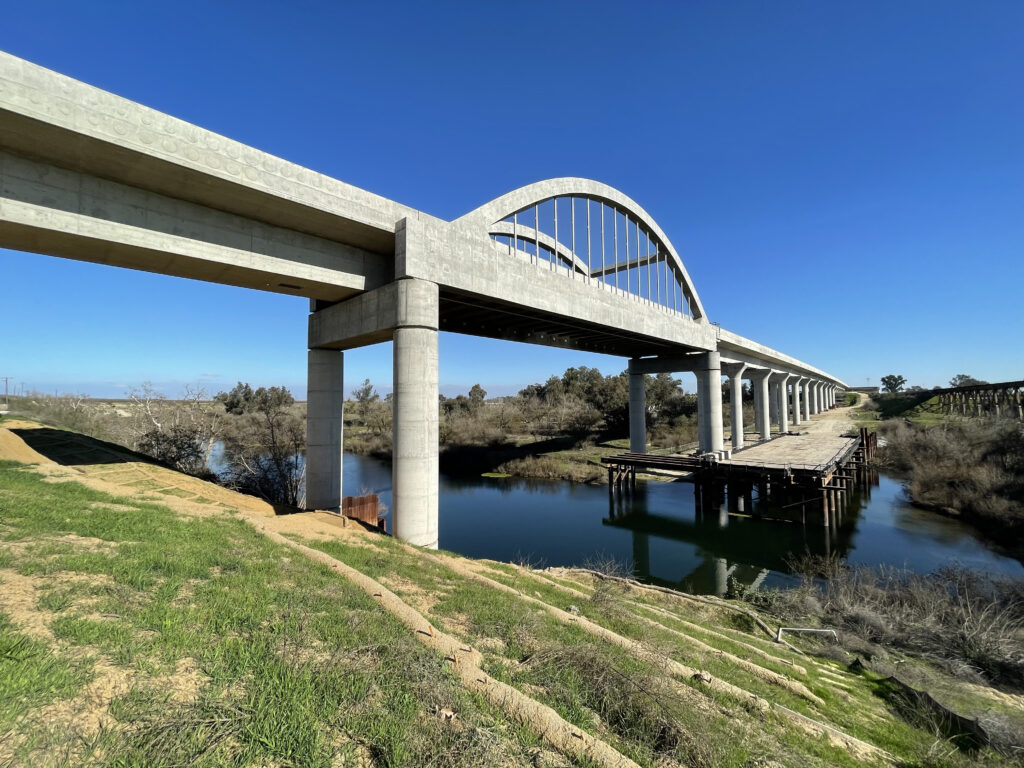
This kind of development, it’s worth noting, still continues in Fresno, as construction of the California High Speed rail will make the city—now home to over one half million people and making Fresno, by some counts, the fifth largest city in California—more thoroughly connected to the rest of the state. Change, moving along swiftly.
In a book about his father, Aram Saroyan traces this theme of moving swiftly to Saroyan’s early life:
At the age of eight, he was among the fastest newsboys in Fresno, relishing the daily contest of ridding himself of his afternoon papers at his corner before his cohorts. A few years later, he was known to be the fastest Postal Telegraph messenger on bicycle in the entire San Joaquin Valley. (26)
This bit of biography informs several aspects of The Human Comedy, including Homer’s—and his boss Mr. Spangler’s—respect for speedy competitions among delivery boys. Spangler tells Homer that he “was probably the fastest-moving thing in the San Joaquin valley” (20). The two also shared a passion for the two-twenty low hurdles. Spangler won the Valley Championship when he was at Ithaca High, and Homer dreams of the same. He explains to little brother Ulysses, “Everyone born in this town runs the two-twenty low hurdles. It’s the big race of Ithaca. The manager of the telegraph office where I work ran the two-twenty low hurdles when he went to Ithaca High. He was Valley Champion” (36). These feats of speed, of course, are accomplishments—along with Mr. Grogan’s lightning telegrapher’s fist (more later)—of mind and body, celebrated in the small-town world of Ithaca, a world, it’s worth noting, that still exists in parts of Fresno, despite its changes.
The house where Saroyan was born, “near the northwest corner of I, Eye, or Broadway and Ventura,” he wrote in an article for American Heritage, is now gone, and Ventura here has been renamed for Cesar Chavez. Instead of a home, among other things, you can find a tattoo parlor and a coffee roasting shop. And a block or so away, California’s High Speed Rail project is constructing an underpass to carry vehicle traffic beneath the tracks, carrying forth Fresno’s rail history.
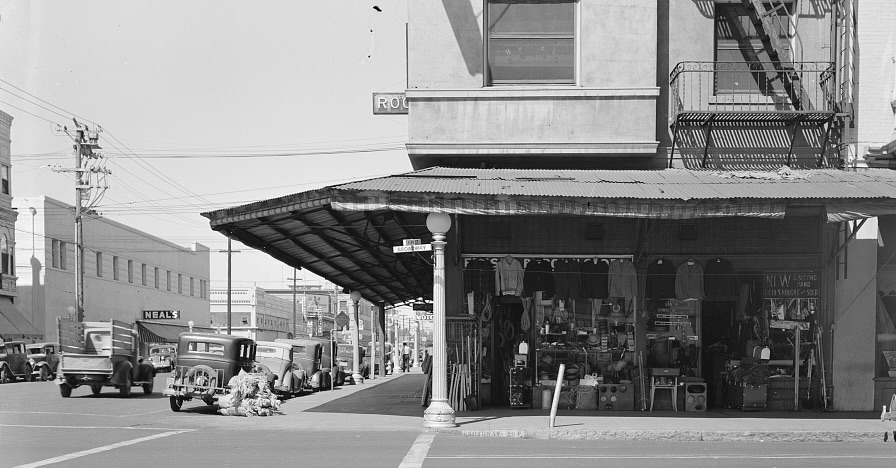
In 1938, near Homer’s time as a messenger, Dorothea Lange photographed the intersection of Broadway (then Highway 99) and Kern, a site also near the location of Saroyan’s birthplace. Unsurprisingly, the small businesses she captured in her portrait are no longer there. Near as I can tell, that geographic location corresponds to somewhere in center field of Chukansi Park, the home of the minor league Fresno Grizzlies.
The stadium’s front gate is modern and imposing. Yet rising above the stadium walls is the fifteen story 1925 Security Bank Building, the site of which again conjures Saroyan’s boyhood era. And plenty of neighborhoods are not unlike the one where Saroyan grew up, including a neighborhood where you will find a modest, 1914 Craftsman bungalow, now a Fresno Historic Landmark, a place which is said to have inspired his depiction of the Macauley home.
Sending and Receiving
In the mythical Ithaca of The Human Comedy, rapid change is happening, just as it did and does in historical Fresno, partly because of the technology that enabled increasingly rapid connections among people and goods, prominently railroads, but also because, quant as it seems in our hyper-connected age, of the telegraph, even then not a new technology but a transforming one.
The core of the novel, of course, is telegraphy, which, among other things, promotes competition, like the races between telegram delivery boys trying to score message pickups from large businesses, like Ithaca Wine or Sunripe Raisin (77). But there’s also a competitive spirit that reaches across the world, represented in Grogan’s skill with his “bug.”
Grogan rails against the company wanting to retire him: “They’ve been wanting to put in the machines they’re inventing all over the place—Multiplexes and Teletypes. Machines instead of human beings!” (30). And Homer listens sympathetically, as he watches Grogan at work on the night shift, hungry, tired, and partly drunk: “He rattled the bug. The answer came and he began to type the telegram, but as he typed he spoke with a kind of pride and vigor which pleased Homer very much. ‘Trying to put me out of my job! Why, I was the fastest telegrapher in the world. Faster than Wolinsky, even, sending and receiving both—and no mistakes. Willie Grogan. Telegraph operators all over the world know that name’” (30-31).
The bug is a semi-automatic telegraphy key that, while not entirely replacing a human being, represents a step in that direction. But for now—for Grogan, who resists the relentless creep of automation—the office contains the whole world, and Willie Grogan is at its center. Unfortunately, the whole world outside the office of the Ithaca branch of the Postal Telegraph Company is aflame, and telegrams often carry the bad news home, bad news that can change everything.

Homer learns this lesson soon after he’s hired. One of his first deliveries is to the home of Mrs. Sandoval. Homer knows the contents of the telegram he carries; it’s news of the combat death of Mrs. Sandoval’s son. Distraught, she asks Homer to read the message to her, and perhaps in an effort to deflect the bad news, she insists on giving Homer candy, and Saroyan emphasizes just how much the experience affects Homer. After his shift finishes around midnight, he returns to his home on Santa Clara Avenue to find his mother waiting up in the parlor. Quiet at first, Homer eventually tells what happened:
“I don’t know how to tell you about this,” he said, “because—well, the telegram was from the War Department. Her son was killed, but she wouldn’t believe it. She just wouldn’t believe it. I never saw anybody hurt that way before. She made me eat candy—made out of cactus. She hugged me and said I was her boy. I didn’t care about that if it helped her. I didn’t even care about the candy.” He stopped again. “She kept looking at me as if I were her boy and for a while I wasn’t sure I wasn’t, I get so bad. . . .”
He stopped talking to walk about the room for a moment. He went on, standing at the open door and looking away from his mother. “All of a sudden,” he said, “I feel different—not like I ever felt before. Even when Papa died I didn’t feel this way. In two days everything is changed. I’m lonely and I don’t know what I’m lonely for.” (33)
Mrs. Macauley—whose oldest son Marcus has also left for war—tells Homer, “The loneliness you feel has come to you because you are no longer a child” (34).
The novel cuts away in various places throughout the novel to show something of Marcus’ Army life, which he shares with his buddy, Tobey George, a lonely soldier who grew up in an orphanage and who is charmed by Marcus’ stories of Ithaca and his family. At one point, the two friends are on a troop train, the first stage of a long journey to war. “I guess we’re on our way at last,” says Tobey (159). The two talk about being afraid to be killed. Tobey asks what Marcus thinks about. The answer is Ithaca: “‘It’s a funny thing,’ Tobey said. ‘Maybe you won’t understand a thing like this, but I feel that Ithaca is my home town, too. If we come out of this O.K., will you take me to Ithaca?’” (159). Marcus doesn’t hesitate, “Sure” (159). Unfortunately, Marcus is killed, but in the end, Tobey still winds up at the Macauley’s front door.
That’s Who We Are
Homer’s story, and the stories of the other characters, combine to reveal Ithaca in granular detail, capturing the rapid changes affecting the town and their own lives. But it’s Mr. Spangler, Homer’s boss, who gives voice to how the downsides of rapid changes are mitigated there. During a Sunday drive south to Kingsburg with his fiancée, in an “old red roadster with the top down” he describes what they’re seeing:
“Those,” he said, pointing to a row of trees bordering a vineyard, “are fig trees. The vines beyond them are Muscat vines. There’s some olive trees. That tree’s a pomegranate. Those vines over there are Malaga vines. There’s an orchard of peach trees. These are apricots. There’s a walnut tree. There’s a tree you don’t see dry often—persimmon. Everything grows in this valley.” (178)
The little automobile moved along parallel with Kings River near the picnic grounds. On this Sunday afternoon five big picnics were going on—with music and dancing— Italians, Greeks, Serbs, Armenians, and Americans. Each group had its own kind of music and dancing. Spangler stopped the automobile at each group for a moment in order to be able to listen to the singing and to watch the dancing. “Those are Greeks over there. I used to know a family of Greeks. That’s the way they dance in the old country.”
The car moved on a short distance and stopped again.
“Those people over there are the Armenians. I can tell from the bearded priests and the lively kids. That’s what they believe in–God and kids.” The car moved on and stopped near another group. “Those people are Slovenians and Serbs, and maybe a few other people from around in there.”
The car moved a short distance and then stopped again.
“Italians. Corbett himself is probably over there somewhere with his wife and kids.”
Now, the automobile came to the last group. The music was loud swing, jive and boogie-woogie, and the dancing was wild. “Americans! Greeks, Serbs, Poles, Russians, Mexicans, Armenians, Germans, Negroes, Swedes, Spaniards, Basques, Portuguese, Italians, Jews, French, English, Scotch, Irish. You name it. That’s who we are.”
They looked and listened, and then the automobile slowly moved away. (179)
“The music was loud swing, jive and boogie-woogie, and the dancing was wild”: Fresno, the best little city in the USA.
Sources
Unless otherwise attributed, all photos by the author.
Armenian Museum of Fresno. “William Saroyan Tour.” 2025. https://www.armof.org/tours/william-saroyan-tour. Accessed 17 November 2025.
California High-Speed Rail Authority. “San Joaquin Viaduct, California.” Public domain via Wikimedia Commons. https://commons.wikimedia.org/wiki/File:San_Joaquin_Viaduct,_2021-02-10_IMG_0271.jpg. Accessed 5 October 2025.
Historicfresno.org. “A Guide to Historic Architecture in Fresno, California.” 2020. http://historicfresno.org/lrhr/082.htm. Accessed 5 October 2025.
Lange, Dorothea. “Fresno. Street corner of San Joaquin Valley town on U.S. 99 showing secondhand store. Caliofornia.” May 1939. Library of Congress. FSI/OWI Collection. https://www.loc.gov/pictures/item/2017772071/. Accessed 4 September 2025.
Leggett, John. A Daring Young Man: A Biography of William Saroyan. Knopf, 2002. Internet Archive. https://archive.org/details/daringyoungmanbi00legg/page/14/mode/2up. Accessed 6 August 2025.
Aram, Saroyan. William Saroyan. Harcourt Brace Jovanovich. 1983. Internet Archive. https://archive.org/details/williamsaroyan0000saro/page/16/mode/2up. Accessed 6 August 2025.
Saroyan, William. The Human Comedy. Dell-Laurel, 1943, 1966. Internet Archive. https://archive.org/details/humancomedy0000will_e5c3/mode/1up. Accessed 8 August 2025.
—-. “Turn back the universe and give me yesterday”: Memories of Fresno. American Heritage. Vol. 31, No. 6. 1980. https://www.americanheritage.com/turn-back-universe-and-give-me-yesterday. Accessed 10 November 2025.
United States Department of Commerce. Fourteenth Census of the United States Taken in the Year 1920: Population 1920 Number and Distribution of Inhabitants. United States Printing Office, 1921. https://www2.census.gov/library/publications/decennial/1920/volume-1/41084484v1ch2.pdf. Accessed 15 October 2025.
United States Department of Commerce. “Fresno City, California.” Census Bureau Profiles. https://data.census.gov/profile?g=1600000US0627000&q=Fresno+city,+California. Accessed 15 October 2025.
United States Department of Commerce. Sixteenth Census of the United States: 1940: Population: Volume I: Number of Inhabitants. United States Government Printing Office, 1942. https://www.census.gov/library/publications/1942/dec/population-vol-1.html. Accessed 15 October 2025.
“Vibroplex.” Wikipedia. https://en.wikipedia.org/wiki/Vibroplex. Accessed 11 November 2025.
Want to be notified when new posts are added? Subscribe to our newsletter.